Stacking
Esempio
In the case of NGC7635 sequence, we first used the Winsorized Sigma Clipping algorithm in Average stacking with rejection section, in order to remove satellite tracks (σlow=4 and σhigh=3).
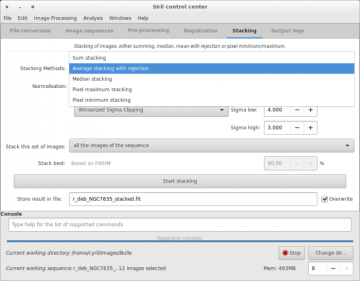
The output console thus gives the following result:⚓
22:26:06: Pixel rejection in channel #0: 0.215% - 1.401%
22:26:06: Pixel rejection in channel #1: 0.185% - 1.273%
22:26:06: Pixel rejection in channel #2: 0.133% - 1.150%
22:26:06: Integration of 12 images:
22:26:06: Normalization ............. additive + scaling
22:26:06: Pixel rejection ........... Winsorized sigma clipping
22:26:06: Rejection parameters ...... low=4.000 high=3.000
22:26:09: Saving FITS: file NGC7635.fit, 3 layer(s), 4290x2856 pixels
22:26:19: Background noise value (channel: #0): 10.013 (1.528e-04)
22:26:19: Background noise value (channel: #1): 6.755 (1.031e-04)
22:26:19: Background noise value (channel: #2): 6.621 (1.010e-04)
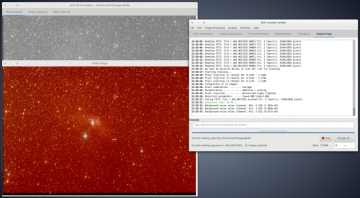
After that, the result is saved in the file named below the buttons, and is displayed in the grey and color windows.
You can adjust levels if you want to see it better, or use the different display mode. In our example the file is the stack result of all files, i.e., 12 files.
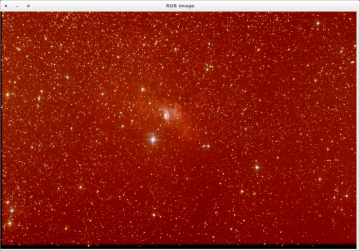
Now should start the process of the image⚓
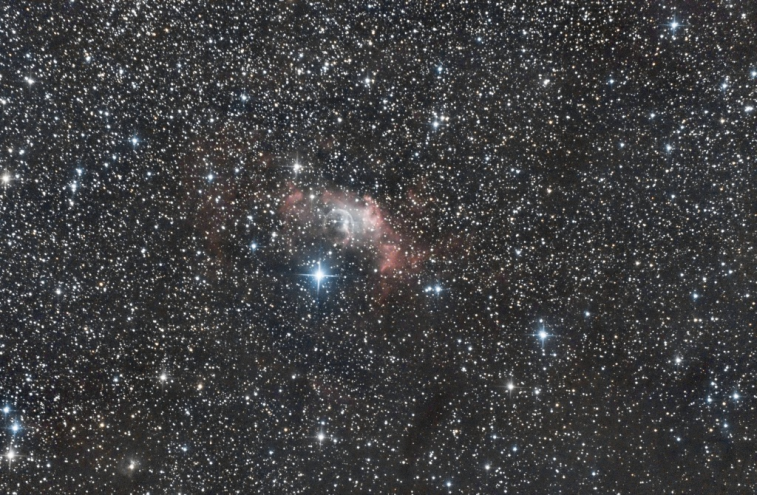
Start the process of the image with crop, background extraction (to remove gradient), and some other processes to enhance your image.
Here an example of what you can get with Siril
SuggerimentoThe purpose of the stack is the gain in signal to noise ratio.⚓
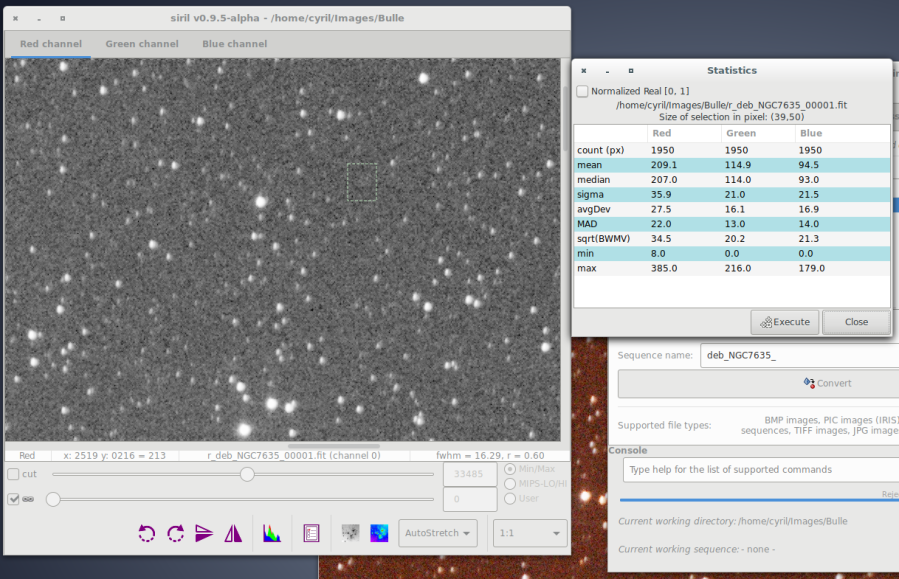
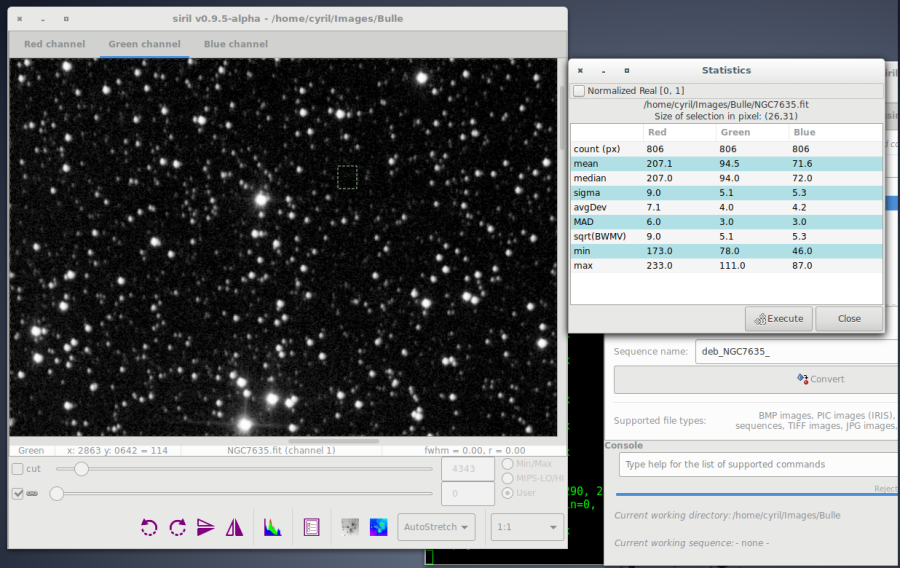
Note the improvement of the signal-to-noise ratio regarding the result given between the first frame before stacking and the result of stacking.
Take a look to the sigma value in the example below.
The increase in SNR is of 21/5.1=4.11≈1√12=3.46 and you should try to improve this kind of result adjusting σlow and σhigh.
first frame
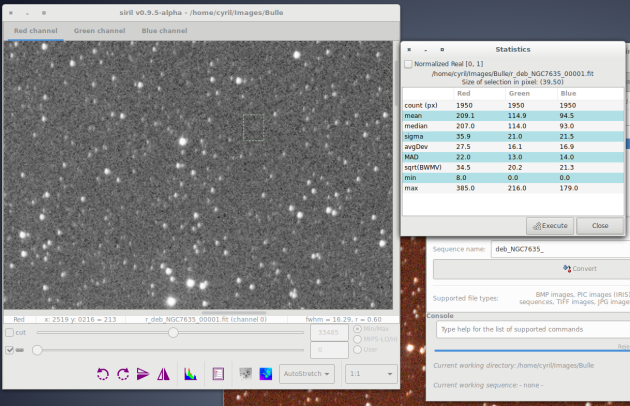
Stacking result